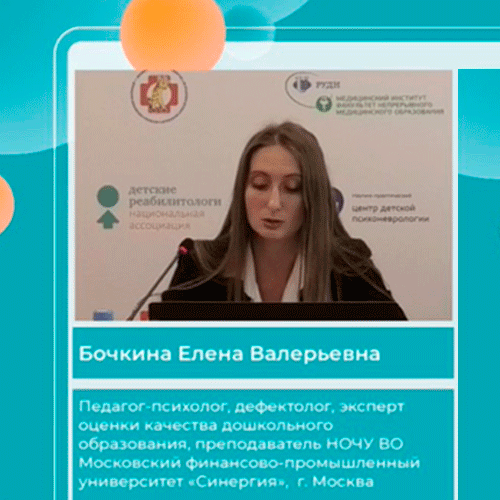
One of the additional parts of her research interests is children cognitive development. In this field she has developed additional general developmental educational program with a natural science focus on developing children’s understanding of the cyclical nature of spatio-temporal processes “Me and Time”, which became the Best Psychological and Pedagogical Programs and Technologies in the Educational environment – 2022. This program in 2024 have become a base for special educational notebook for preschool children and produced jointly with the flagship of the Russian watch industry – the NIKA watch factory. At the same time (2024), she has become the judge of the main industry award in the field of goods and services for children in the Russian Federation – “Golden Bear”. This award is dedicated to examination toys, educational tools and furniture for kids.


Additionally, she leads work with children with attention deficit hyperactivity disorder (ADHD), dyslexia / dysgraphia and autism. For them she has created a special diagnostic card (questionnaire of comorbid disorders) and tools for work (notebook for teaching writing and tools for spatial-temporal orientation).
About “Me and Time” program
The relevance of the “Me and Time” science program is based on the fact that navigating the world around us directly depends on determining one’s position in time and space. This skill enables preschoolers to take a step toward mastering a necessary activity for school age—learning. This is because, through familiarization with the structure of spatio-temporal cycles and their mechanisms, children master all mental operations (analysis, synthesis, comparison, classification, etc.). This helps them transfer their knowledge to any learning task, having first identified its main characteristics, and implement a step-by-step solution.


The “Me and Time” science program teaches older preschoolers how to navigate time and space and fosters understanding of the cyclical nature of spatio-temporal processes through the child’s appropriation of cultural markers—topographic maps, signs, diagrams, and analog clocks. This allows them to work with children in their zone of proximal development. The program’s structure is formed by a vertical system consisting of three interconnected thematic modules:
− “Introduction to Opposites”;
− “Magical Transformations”;
− “The Wheel of Time.”
The content of the modules is built on the principle of “from simple to complex,” with the first module being the simplest and the third the most complex. The educational objectives of the modules are cyclical in nature and involve a gradual increase in the complexity of the learning material. Each formative task was aimed at building a system of knowledge about an element of the spatio-temporal cycle, working on one of the logical thinking processes (seriation, transformation, stagnation, classification), and reflecting on the work accomplished.


Work within the program is based on the reconstruction and understanding of vital events for the child, based on annual, daily, and other cycles within a clearly defined adult structure (a sheet of paper divided into 2, 3, or 4 parts). This structure becomes a kind of “matrix” for the child, through which they view life processes. In the initial stages, children “frame” their life experiences within a given structure, highlighting the most important elements, i.e., identifying the significant features of an event. After successfully mastering this stage, the child independently attempts to transfer the acquired knowledge to another learning task, thereby creating new interdisciplinary and intradisciplinary connections. Thus, working with a program dedicated to developing understanding of the cyclical nature of spatiotemporal processes enriches the intellectual development of older preschoolers and promotes the development of cognitive processes essential for successful school learning.
Target Group of the Program
The program is designed for preschoolers aged 5-6, including those with disabilities and mild psychomotor developmental delays.
This age group was chosen because older preschoolers are sensitive to conflict situations, making this age period the most favorable for developing understanding of the cyclical nature of spatiotemporal processes.
Objective: To develop cognitive functions by developing an understanding of the cyclical nature of spatio-temporal processes in older preschoolers.
Program Aims:
– By creating a situation of immersion in the material (elements of the surrounding world, activities, artistic and aesthetic activities, etc.), to expand the understanding of the cyclical nature of spatio-temporal processes;
– To develop the ability to navigate using topographic maps, analog clocks, natural phenomena, cultural signs and symbols;
– To promote the meaningful enrichment of knowledge and understanding of daily, lunar, and annual cycles;
– To develop the child’s ability to construct cycles through various types of developmental activities (LEGO construction, discussion, experimentation, artistic and visual activities, etc.);
– To foster children’s experimentation by encouraging actions aimed at transforming objects, subjects, objects, and learning situations.
The work includes various forms of individual creativity by the child, as well as his or her assistance, cooperation, and co-creation with peers and adults – teachers and psychologists.